Featured post

Nymphs of Green Shield Backed Bug: Coleotichus costatus

Nymphs of Green Shield Backed Bug sitting on Red-Eyed Wattle. Note the seeds and the seed pods. Nymphs of Green Shield Backed Bug wit...

Showing posts with label Shield Bug. Show all posts

Thursday, 21 July 2016

Pittosporum Shield bug: Pseudapines geminata

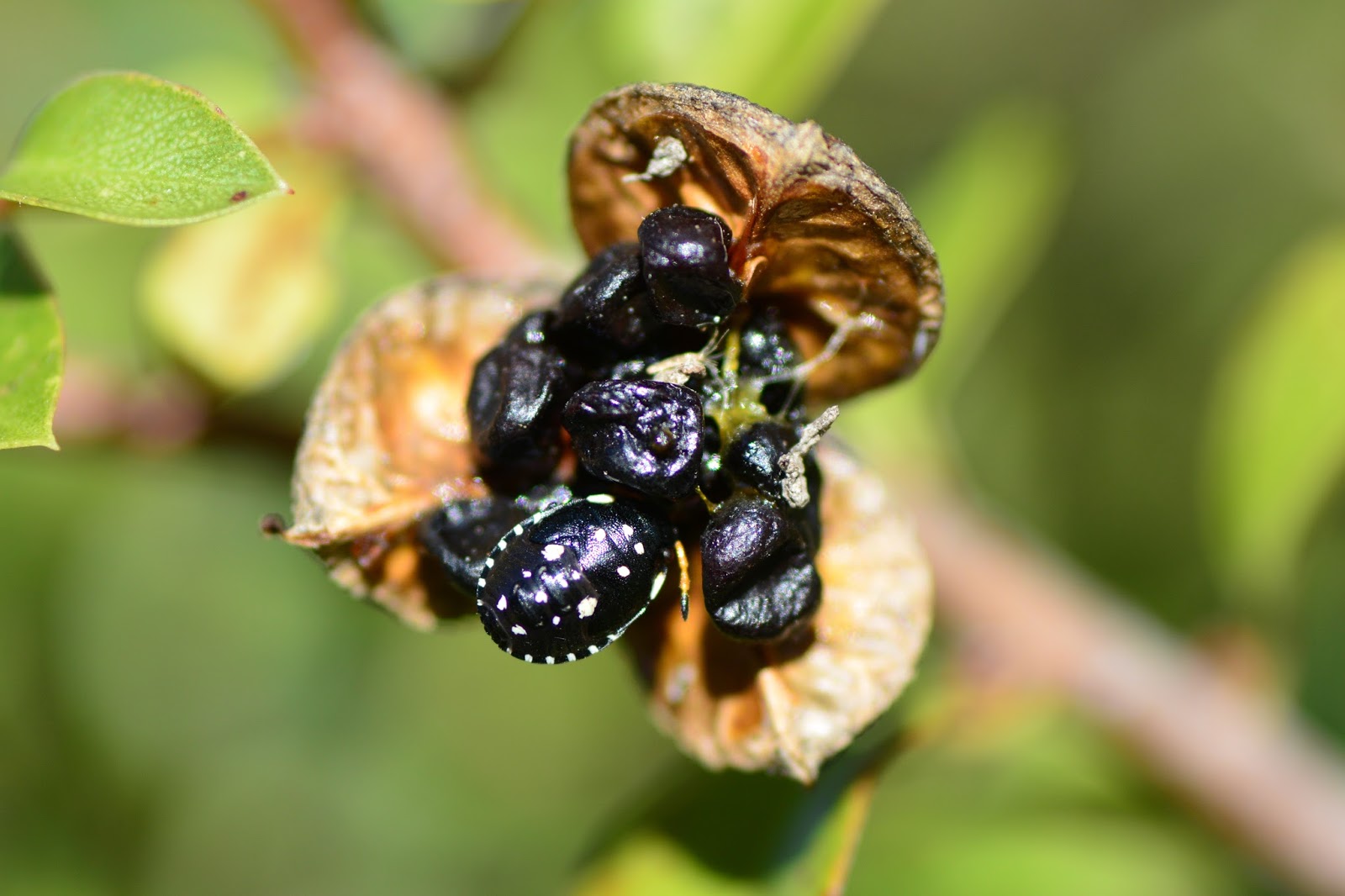
3rd or 4th instar nymph of Pittosporum shield bug among the seeds in the pod of Karo plant.

Adult Pittosporum shield bug

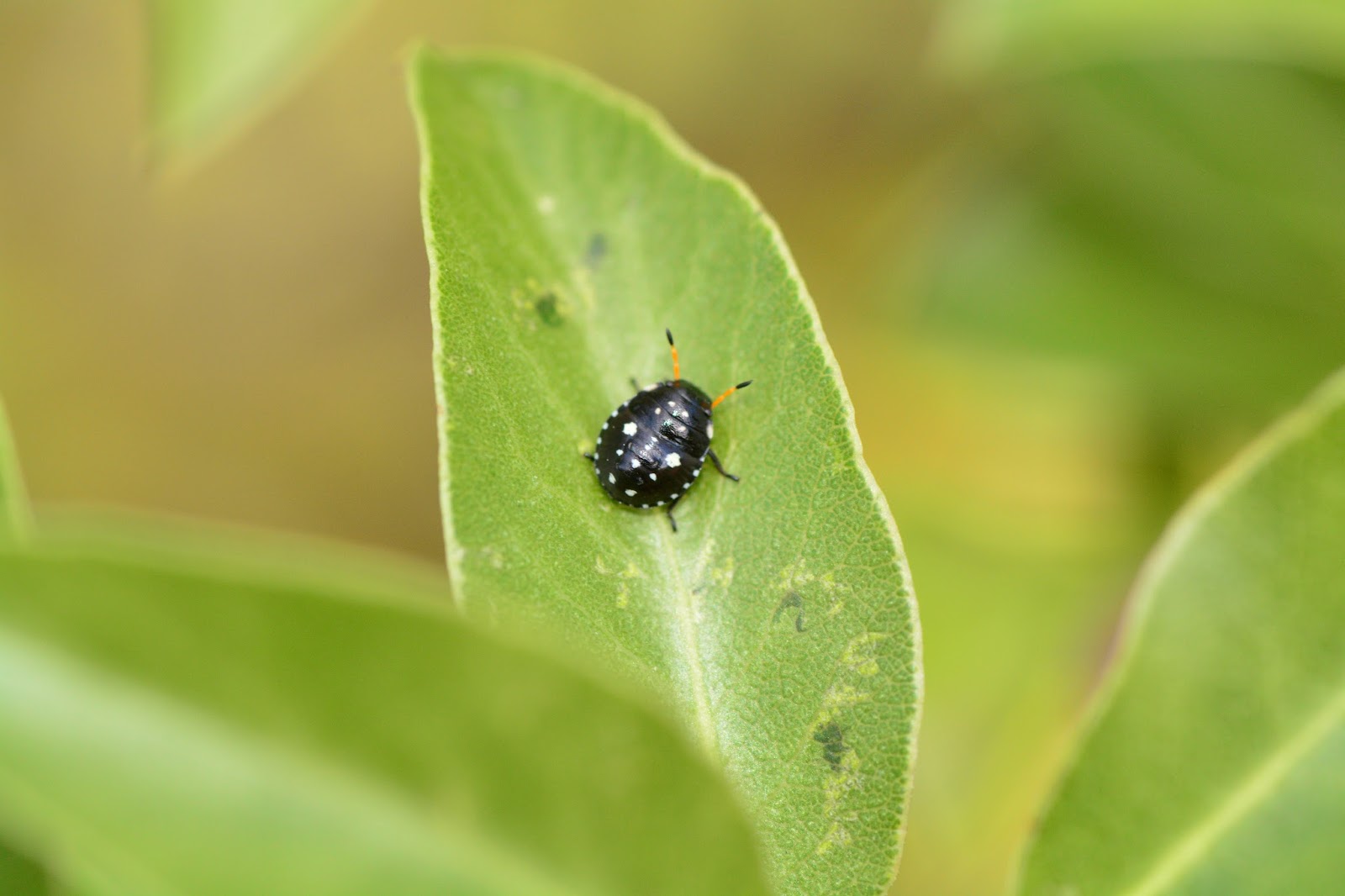
Nymph of Pittosporum Shield Bug

Early instar nymph of pittosporum shield bug
Class: Insecta
Order: Hemiptera 
Suborder: Heteroptera
 Infraorder: Pentamomorpha
 Superfamily: Pentatomoidea 
Family: Pentatomidae
Genus: Pseudapines 
Pseudapines geminata 

Pittasporum is a genus of shrub native to New Zealand, Australia and parts of Asia and Africa. Whereas some Pittosporum plants such as Sweet Pittasorum, Pittasporum undulatum, are common in East coast, many Pittasporum plant species are introduced to Western Australia. Along with the plant, the shield bug that is specific to the host plant is also introduced. The above plant that grows in my garden in Bunbury, WA is P. crassifolium, commonly known as Karo in New Zealand, with different stages of the corresponding shield bug on it.

The nymphs of Pittosporum Shield Bug: The early instar nymphs are about 2 to 3 mm in size and circular in shape. The black body has symmetrical white spots. They lack wings, as any nymphs of hemiptera. The antennae are orange in colour, the last segment is black. They are shy and hide behind the leaves when disturbed.

The adults of the Pittosporum Shield Bug: The adults have wings. The shield shaped body is dull black with white spots. The outer edges of wings, thorax and the abdomen are orange in colour.  The first two segments of the antennae are orange in colour, followed by alternating black and orange segments.

The relationship between the Pittosporum plant and the shield bug is that of symbiosis based on mimicry complex. The seed pods are three valved capsules which split to expose black sticky seeds with in. The nymphs and the adults of Pittosporum Shield Bug are black in colour with white spots which make them look very similar, almost indistinguishable from the seeds. The seeds serve as food for the shield bug. The shield bugs use their piercing mouth parts to suck the nutrients through the hard outer layer of the seed. When birds and other insects predate on the shield bug, they also carry the sticky seeds with them which helps in dispersion of the seed and propagation of the plant. The shield bugs protect themselves by releasing an alkaloid cocktail which can cause an allergic reaction to the predators (and to humans who handle the insect). These shield bugs are widely regarded as pests of this garden decorative plant, which itself is not native to the region.

reference: Guide To Wildlife of Perth And South West

Wednesday, 9 December 2015

Nymphs of Green Shield Backed Bug: Coleotichus costatus

Nymphs of Green Shield Backed Bug sitting on Red-Eyed Wattle. Note the seeds and the seed pods.
Nymphs of Green Shield Backed Bug with the Red-Eyed Wattle pods.
Location: Bunbury
Season: Early Summer 
Class: Insecta 
Order: Hemiptera 
Suborder: Heteroptera 
Infraorder: Pentatomomorpha 
Superfamily: Pentatomoidea 
Family: Scutelleridae
Coleotichus costatus

These colourful nymphs were found on Red-Eyed Wattle (Acacia cyclops).

Relationship between Red-Eyed Wattle and Green Shield Backed Bug
Red-Eyed Wattle has dry twisted pods within which lie glossy black seeds encircled by two folds of a large orange to bright red fleshy stalk-like structure. The black seed looks like an eye and the surrounding orange-red aril looks like a stalk, giving it the name Red-Eyed Acacia and the botanical name cyclops (stalk eyed).The seeds attract ants and birds. Birds like Honey-eaters and Wattle Birds feed on the seed, digesting the red aril and excreting the black seed which helps in dispersion of the seed and propagation of the plant. The interaction with ants is one of the most important mutualistic mechanisms for seed dispersal. Ants carry the seed with the encircling aril into their underground nests. The aril is nutritious but the ant cannot pierce the hard seed. The seeds are cast away, sometimes burst out of the nests during bush fires, helping the dispersal of the seed and propagation of the plant. This process is called Myrmecochory.

Red-Eyed Wattle is one of the known host plants for Green Shield Backed Bug. The nymphs and adults feed on the plant. Their piercing mouth parts are strong enough to penetrate the hard seed. The nymphs of the Green Shield Backed Bug resemble the seed and almost indistinguishable from the seeds unless examined closely. This a mimicry model. The insect nymph is at risk of predation from birds due to its bright colour. This has probably been exploited by the plant which mimics the insect to get the attention of birds for seed dispersal. Hence, the nymph may be the model and the seed may be the mimic.

The bugs have evolved to protect themselves. In order to deter the predators, these shield bugs emit toxic alkaloids. These alkaloids can be emitted when the bug is handled by humans as well. These chemicals are also responsible to the 'stinkiness' of the stink bug. They also have strength in numbers. They line up resembling a longer insect (like a caterpillar) to confuse the predators. The adult has the colouring of the seed pod. It camouflages itself from the predators, contrary to the nymphs which stand out.


Description of Green Shield Backed Bug
Life Cycle of Coleotichus costatus
Top left: Eggs hatched
Top right: Early instar nymphs
Bottom left: 4 or 5th instar nymph
Bottom centre: ecdysis nymph to an adult
Bottom right: adult nymph
Eggs: These hatched eggs are typical of hemiptera eggs. They have pearlescent shine and a neatly cut circular cap from which the nymph has emerged. It was found on the pod of the Red-Eyed Wattle.
Early Instar nymphs: These are tiny, about 2 cms in length. They closely resemble the red eyed wattle seeds. They have dark dark centre with an encircling red pattern. They are highly iridescent.
4 to 5th Instar nymphs: (given the progression of the wing bud and the 3 segment antennae). These nymphs are 2 - 3 cms in length, much bigger than the seed. They have a red and green iridescent pattern.
Just hatched adult: Immdediately after ecdysis, the adult is pink in colour. It has a smooth body and doesn't use its wings. It was noticed that the adult crawled out of the shell, rather than flying out. As they grow, the colour of the adult body changes. The pink gradually becomes brown. It develops green metallic patches on the body which shine with the light. The colour is very similar to the seed pod of the red-eyed wattle, offering it camouflage and protection from predators. The adults are shy, slow moving and were not seen flying at all.
The adults have a simple eye, one red dot above each of the compound eyes.

The family Scutelleridae is a family of Jewel Shield Bugs. Most Shield Bugs of this family have bright colours and metallic sheen making them one of the most attractive bugs of the Hemipterans. The famous Cotton Harlequin Bug belongs to this family. It is only found in East Coast of Australia. The West Coast has Red Jewel Bug which has different markings on the abdomen than the Green Backed Jewel Bug. 

These Shield Bugs are True Bugs. They often confused with beetles (Coleoptera), which are essentially very different to the Hemipterans. A few general features of Hemiptera can be seen here.

Different stages of the Coleotichus costatus showing the Red Eyed Wattle seeds and seed pods.
Fully grown adult
Ecdysis, 5th instar nymph and adult
exoskeleton after ecdysis
References:

Tuesday, 28 April 2015

Common Gum Tree Shield Bug: Poecilometis patruelis


Adult Common Gum Tree Shield Bug
the red colour is because it has just moulted. The body darkens gradually.
Location: Bunbury
Season: Summer, December/January
Order: Hemiptera 
Suborder: Heteroptera 
Infraorder: Pentatomomorpha 
Superfamily: Pentatomoidea
Family: Pentatomidae
Tribe: Halyini
Poecilometis patruelis 
(Eumecopus patruelis)

All the stages of this Shield Bug were taken from my garden (which has a backdrop of bush with lots of gum trees). Identification of this Shield bug has been quite an interesting process. There are many genera and species of Shield Bugs that live on Gum Trees in Australia and they share many morphological similarities. Brisbane Insects has been a great resource for identification which mentions Mullerian Mimicry Complex. They mimic each others' features in order to ward off a common predator. Similar Shield Bugs are Gum Tree Shield Bug (Theseus modestus), Two-dots Shield Bug (Poecilometis monteithi), Brown Shield Bug (Poecilometis Sp.). They are identified based on wing venations, segments of antennae and placement of mouth parts. Common Gum Tree Shield Bug is the commonest in the region, hence the identification.
Egg shells 
2nd or 3rd Instar Nymph

3rd or 4th Instar Nymph
Adult Common Gum Tree Shield Bug
General Features of Family Pentatomidae:

1. Pentatomidae: Greek for 5 sections referring to the body shape which has 5 parts (Pronatum, Scutellum, 2 pairs of wings and membranous area at the tip). They have a hardened scutellum, resembling a shield, hence the name Shield Bug.
2. They have glands that release foul smelling substances to avert predators.
3. Segemented Antennae (4 to 5 segements).
4. Piercing mouth parts, even in the nymphs.
5. Wings: They belong to suborder Heteroptera (Greek for different wings)
The fore wings are known as hemelytra. The base of each wing is hardened. The tips of the fore wing and hind wings are thin. 
6. The eggs hatch into Nymphs which moult to lose the exoskeleton in 5 different stages. They are referred to as Instars. The nymphs have sucking mouth parts. They don't have wings, hence flightless.

Monday, 22 December 2014

Adult Rutherglen Bug With Its Nymphs


Rutherglen Bug, Nysius Vinitor with First Instar Nymps on its body
sitting on Viburnum Tinus

Rutherglen Bug
Location: Bunbury, Western Australia
Season: Summer

Order: Hemiptera 
Family: Lygaeidae 
Genus: Nysius
Nysius vinitor

My garden is full of these lately. I spotted a rather tiny Rutherglen Bug with what appeared to be orange dots. When looked at closely, these were the nymphs stuck on its body. Probably one of the few colourful pictures of very ordinary looking Rutherglen Bug on the internet!

Rutherglen Bug is very tiny, about 0.5 mm in length, looks like a very tiny fly. It takes flight at the slightest disturbance. There quite a few around here that keep flying to sit on my hands. These are Australian and they attack some major crops. See references.

References: www.daff.qld.gov.au CSIRO