Featured post

Nymphs of Green Shield Backed Bug: Coleotichus costatus

Nymphs of Green Shield Backed Bug sitting on Red-Eyed Wattle. Note the seeds and the seed pods. Nymphs of Green Shield Backed Bug wit...

Showing posts with label antennae. Show all posts

Wednesday, 24 December 2014

Black Pintail Beetle: Tomoxioda aterrima

Tumbling Flower Beetle on African Daisy
Tumbling Flower Beetle
Filiformis Antennae of Tumbling Flower Beetle
Location: Western Australia, South West Region
Season: Summer, December

Class Insecta
Order: Coleoptera
Suborder: Polyphaga
Superfamily: Tenebrionoidea  
Family: Mordellidae (Tumbling Flower Beetles)

Updated on 2/12/2015
Correction of identfication: This beetle looks like a Black Pintail Beetle - Tomoxioda aterrima
Originally Identified as Tumbling Flower Beetle


A tiny black insect with shimmering gold and silver bands was found on the African Daisy flower. It is the Tumbling Flower Beetle Black Pintail Beetle; Tomoxioda aterrima. The pintail, which is a projection of the abdomen and its arched back are prominent features. What made me think it was a beetle is the filiformis antennae (present in certain beetles and cockroaches). The behaviour of the beetle confirmed my diagnosis. It rolled itself up with its pointy tail, fell upside down - played dead, and just waited there for the predator (me with my camera pointed close to it) to go away. It leapt and jumped out to disappear from my sight. The tumbling action got me worried for the little one but the fact that this action is a defence mechanism put my mind at ease. It must be okay somewhere.

Reference: Bug Guide
Brisbane Insects

Tuesday, 23 December 2014

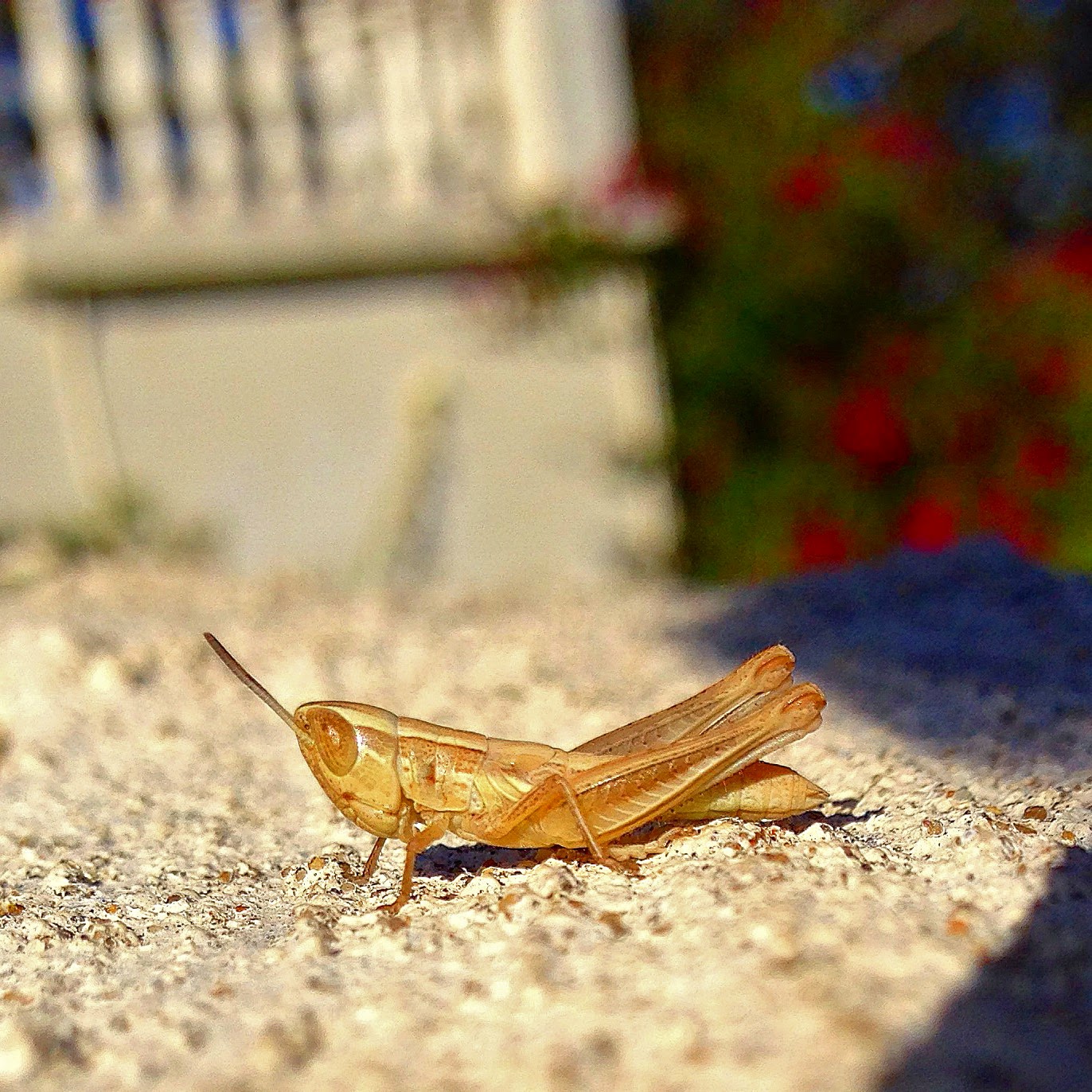
Grasshopper Nymph

This is probably the cutest thing I have ever seen, a baby grasshopper! This nymph was spotted jumping up and down in our garden from mulch to dry grass to pavement. It has the perfect camouflage and jumps away even before you can get a look, let alone click a picture.  

I am pretty chuffed I got this shot! Look closely and I'll tell you why it is a grasshopper and not a cricket.
Grasshopper Nymph

The antennae are short, shorter than the cephalus, the head, which distinguishes it from a cricket. Crickets have antennae longer than their heads. Grasshopper nymphs do not have wings. The nymphs have remnants of semi rigid wings which fully form when they grow up to be adults. 

The most interesting fact is that Grasshoppers have 'ears' (Tympanum, auditory sensory organ) on their first abdominal segment, behind the third pair of legs. You can actually see the ear like structure in the picture below! Look behind the behind the feather like corrugated hind limb.
Macro image of Grasshopper Nymph
Macro Image of Grasshopper nymph with it's tympanum marked out.
While the Grasshoppers have their ears on their abdomen, crickets have it on their fore legs!

I have concluded that it is a nymph of the common field grasshopper of genus Chorthippus.

Location: Western Australia, South West
Season: Summer, December
Spotted in daytime.

Subphylum: Hexapoda 
Class: Insecta 
Order: Orthoptera 
Suborder: Caelifera
Family: Acrididae 
Genus: Chorthippus

References: Brisbane InsectsWikipedia

Saturday, 20 December 2014

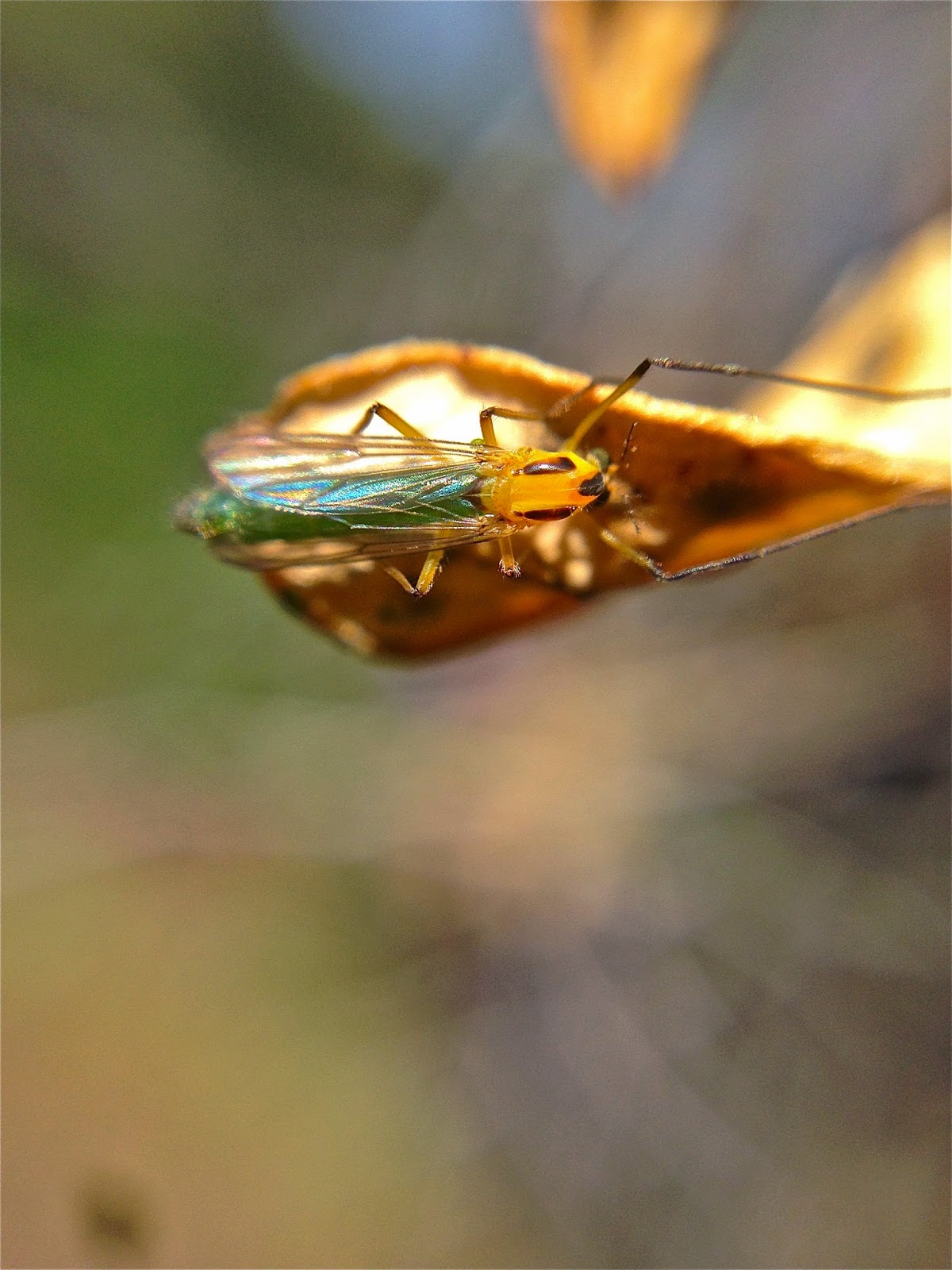
The Green Mosquito: Chironomid Midge

Male Chironomid Midge on Hare's Tail Grass (or the Bunny Tail Grass, Lagurus Ovatus)
Yellow Chironomid Midge on Lagurus Ovatus.
Yellow Chironomid Midge
The Big Swamp Wetland, Bunbury is a great place for bike riders. It is my favourite place to ride. My bike rides are made more interesting by the different insects I spot. This was one of them. It was so tiny that I could only see it with my macro lens. It looked like a mosquito, but green in colour. It was clinging on to the Hare's Tail Grass. The bright green body against the pale green Hare's Tail Grass was a standout. The plumose antennae on top of the feathery weed was a pretty sight to see through the lens. Not to mention the tiny iridescent wings! The yellow midge with bright yellow head contrasting the green body with black oval eyes did not have the feathery plumose antennae as prominent as the green midge (making me think it could be a female, due to lack of plumose antennae).

There were a group of them clinging on to the weed, basking in the sun. The sun worked against me to take a good picture but the insects were still enough for me to find an angle to shoot. I love those times when the insects pose for me!

This is the Chironomid Midge, also known as the Green Midge. It is a non biting midge related to the notorious biting midges (Ceratopogonidae). The resemblance to mosquitos is because they belong to the same suborder of Nematocera (characterised by thin, filamentous, segmented antennae) and to the same infraorder Culcimorpha. The mosquitos branch off into the superfamily Culicoidea and midges branch off into the superfamily of Chironomidae. 

I am not sure what genus or species the one I photographed belongs to. Apparently there are so many obscure species of Chironomidae that it needs cytogenetic confirmation using their Polytene Chromosomes*. Genetically interesting fact about Chironomidae is that the Polytene Chromosomes were first discovered in the salivary glands of these midges (Balbiani in 1881) much before the hereditary pattern was studied in fruit flies. The salivary glands of chironomids are still used for the study of polytene chromosomes.

Chironomids are ecologically important. Many species of Chironomids adapt easily to anoxic conditions in polluted water. The larvae are red due to haemoglobin content which helps them get as much oxygen from the toxic environment. The abundance of Chironomids indicate low biodiversity in the ecological system due to presence of high level of pollutants. Chironomids are the food for fish and many aquatic organisms. The presence of midges in Western Australian wetlands is supposedly a nuisance for people's outdoor activities. This is because they are attracted to and cluster around UV light sources. They are small enough to pass through fly meshes. 


Location: Big Swamp Wildlife Park, Bunbury, Western Australia
(seasonal fresh water wet land)
Season: Spring (October)
Order: Diptera  
Suborder Nematocera
Infraorder: Culicomorpha
Superfamily: Chironomoidea
Family: Chironomidae 


*Polytene Chromosomes are formed through repeated DNA replication without actual cell divison hence they are easily identified by banding patterns. The pattern inversions and deletions help in species identification.

References: BugGuide, Wikipedia, Public Health WA, MDFRC.ORG.AU, www.armadale.wa.gov.au