Featured post

Nymphs of Green Shield Backed Bug: Coleotichus costatus

Nymphs of Green Shield Backed Bug sitting on Red-Eyed Wattle. Note the seeds and the seed pods. Nymphs of Green Shield Backed Bug wit...

Showing posts with label Pest. Show all posts

Thursday, 21 July 2016

Pittosporum Shield bug: Pseudapines geminata

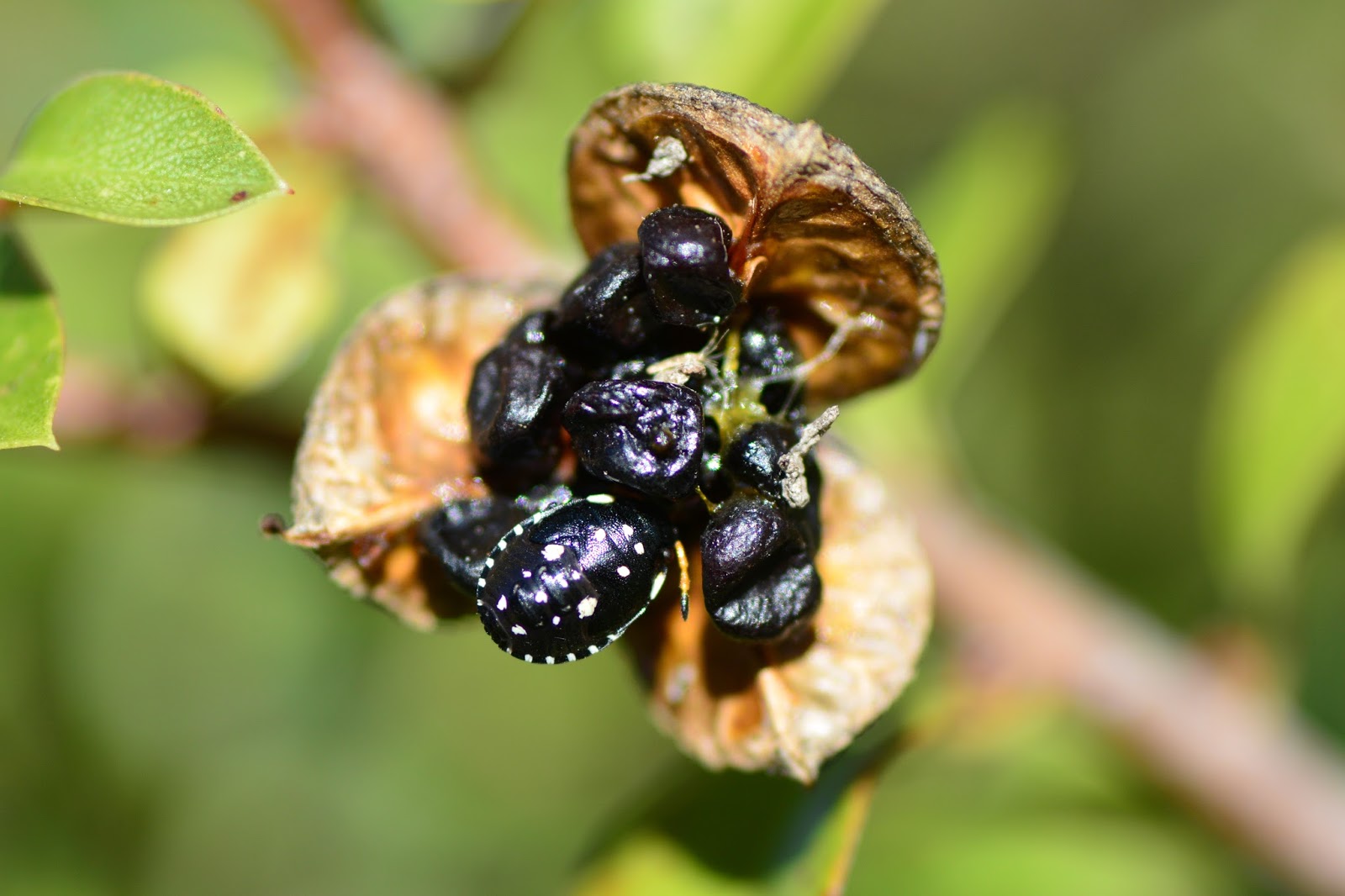
3rd or 4th instar nymph of Pittosporum shield bug among the seeds in the pod of Karo plant.

Adult Pittosporum shield bug

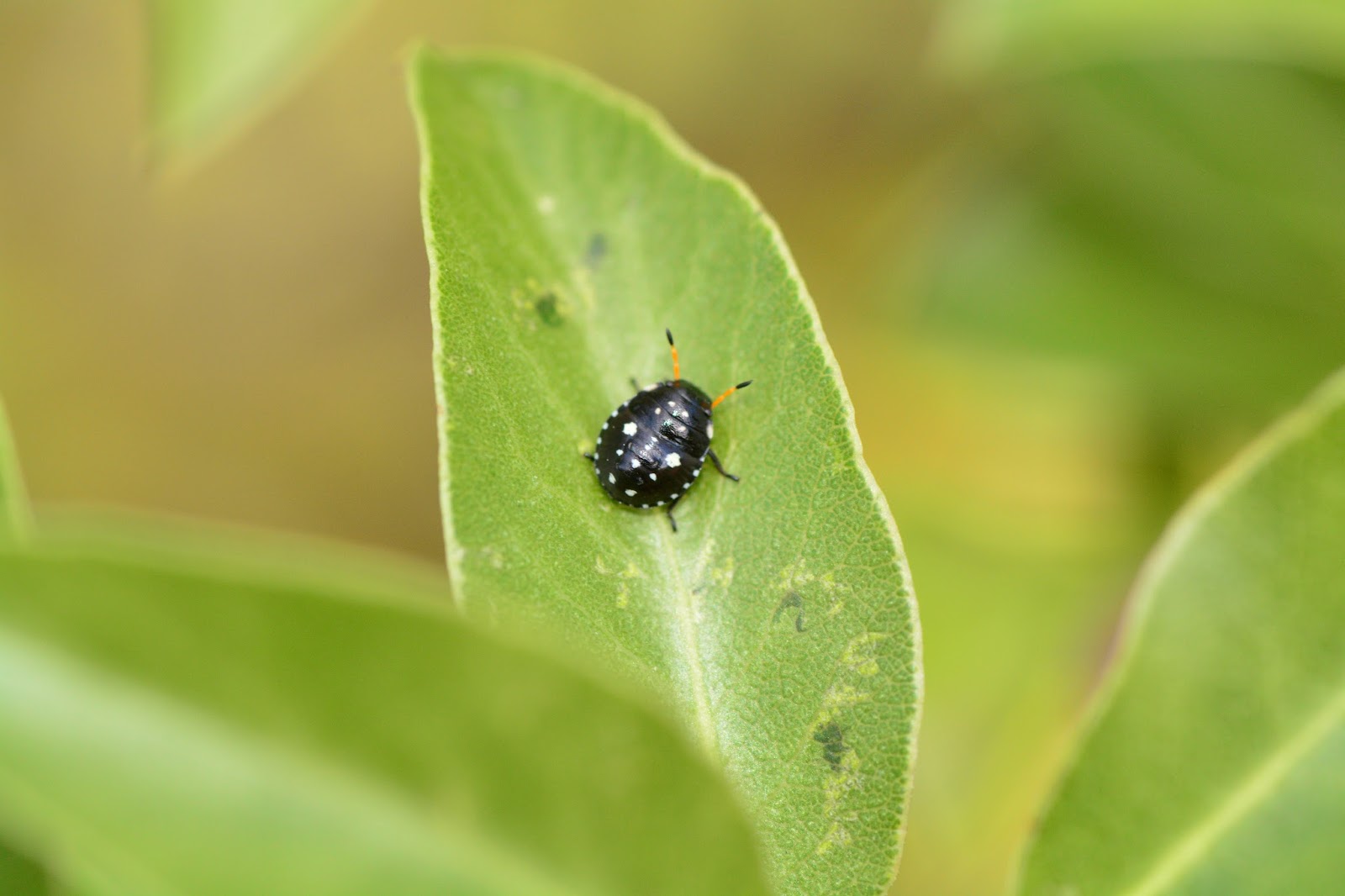
Nymph of Pittosporum Shield Bug

Early instar nymph of pittosporum shield bug
Class: Insecta
Order: Hemiptera 
Suborder: Heteroptera
 Infraorder: Pentamomorpha
 Superfamily: Pentatomoidea 
Family: Pentatomidae
Genus: Pseudapines 
Pseudapines geminata 

Pittasporum is a genus of shrub native to New Zealand, Australia and parts of Asia and Africa. Whereas some Pittosporum plants such as Sweet Pittasorum, Pittasporum undulatum, are common in East coast, many Pittasporum plant species are introduced to Western Australia. Along with the plant, the shield bug that is specific to the host plant is also introduced. The above plant that grows in my garden in Bunbury, WA is P. crassifolium, commonly known as Karo in New Zealand, with different stages of the corresponding shield bug on it.

The nymphs of Pittosporum Shield Bug: The early instar nymphs are about 2 to 3 mm in size and circular in shape. The black body has symmetrical white spots. They lack wings, as any nymphs of hemiptera. The antennae are orange in colour, the last segment is black. They are shy and hide behind the leaves when disturbed.

The adults of the Pittosporum Shield Bug: The adults have wings. The shield shaped body is dull black with white spots. The outer edges of wings, thorax and the abdomen are orange in colour.  The first two segments of the antennae are orange in colour, followed by alternating black and orange segments.

The relationship between the Pittosporum plant and the shield bug is that of symbiosis based on mimicry complex. The seed pods are three valved capsules which split to expose black sticky seeds with in. The nymphs and the adults of Pittosporum Shield Bug are black in colour with white spots which make them look very similar, almost indistinguishable from the seeds. The seeds serve as food for the shield bug. The shield bugs use their piercing mouth parts to suck the nutrients through the hard outer layer of the seed. When birds and other insects predate on the shield bug, they also carry the sticky seeds with them which helps in dispersion of the seed and propagation of the plant. The shield bugs protect themselves by releasing an alkaloid cocktail which can cause an allergic reaction to the predators (and to humans who handle the insect). These shield bugs are widely regarded as pests of this garden decorative plant, which itself is not native to the region.

reference: Guide To Wildlife of Perth And South West

Friday, 11 September 2015

Green Peach Aphid: Myzus persicae


Location: Bunbury
Season: Winter
Class: Insecta 
Order: Hemiptera 
Family: Aphididae
Myzus persicae

Aphids devastate crops but they are fascinating insects with intricate anatomy and a graceful flight. The above is a winged Green Peach Aphid that I found resting on Purple Pea Bush on a sunny winter afternoon. It was hopping from place to place and hopped onto my finger. With a sluggish movement, it rested on my hand for a minute or so and them took off in a flight so sluggish that every step of its flight was easily witnessed.

This insect is yellow in colour with a prominent black area on the dorsum of the mid abdominal segments from 3 to 6. There are laterally placed black bars on the other segments. The limbs, antennae and the head are all dark. The eyes are red. The genus Myzus is identified by convergent antennal tubercles and lack of clavate sipunchuli. 

Green Peach Aphid can affect a wide variety dicotyledon plants including agricultural crops such as potato and peach. Like other aphids they are vectors of various viral diseases of plants. As with aphids in general, in warmer weather they reproduce asexually producing about 12 generations in a year. In colder weather, they reproduce sexually laying eggs on various plants on which the hatched nymphs feed.

Ladybirds, Lacewings are natural predators that are used in biological control of these aphids. 

References:

Melaleuca Psyllid: Boreioglycaspis melaleucae


Loation: Bunbury
Season: Late Summer
Class: Insecta
Order: Hemiptera
Family: Psyllidae
Boreioglycaspis melaleucae

Melaleuca trees, commonly called Paperbarks, are native to Australia. Melaleuca Psyllid is a jumping plant louse that sucks the sap of the Melaleuca plant and destroys plant. Melaleuca is an introduced species in USA, especially in South Florida. It is an aggressive invader that displaces native vegetation. Melaleuca Psyllid is jumping plant louse that is introduced as a biological control of the invasive Melaleuca plant.

The above psyllid was found in my veggie garden which has a backdrop of a gum tree wooded area. This tiny psyllid is yellow in colour with black markings on its head, thorax and abdomen. There are a pair of red Genae protrude from underneath the eyes which resembles a tongue (on my hand, it looks like it is licking my skin!). The eyes are pale green with a conspicuous black dot. There is a Y shaped black mark on the head extending to the thorax. The wings are transparent with a thin yellow margin. The abdomen has horizontal black stripes. it is triangular in males ending with genitalia. The female, as seen above has a rounded abdomen.

The psyllid was not very active and readily jumped on my hand and stayed there for the whole photo shoot. It flew away after sometime.

References:

Penthimiin Leafhopper: Neovulturnus

Class: Insecta 
Order: Hemiptera 
Suborder: Auchenorrhyncha 
Infraorder: Cicadomorpha 
Superfamily: Membracoidea 
Family: Cicadellidae 
Subfamily Penthimiinae
Neovulturnus 

Also known as Enamel Leafhopper, this Penthimiin Leafhopper has a filigree pattern on its rounded shield-like body. The flat head has two laterally placed eyes. The wings are short and when I observed it, it hopped rather than flew. It barely moved and was easily photographable. 
Like all leafhopppers, this Enamel Leafhopper has a tent shaped wings. It is regarded as an agricultural pest. It attacks crops, hence of economic significance. It directly feed on the leaves and plants. More importantly it is a vector and transmitter of various viruses which infect the plants and destroy them.

Edit: 22/2/2019 This leafhopper belongs to genus Neovulturunus, undeacribed species in Western Australia. Thanks to Dr Melinda Moir for clarification. 


Common Brown Leafhopper: Orosius orientalis

Nymph of common brown leafhopper


Class: Insecta 
Order: Hemiptera 
Suborder: Auchenorrhyncha 
Infraorder: Cicadomorpha 
Superfamily: Membracoidea 
Family: Cicadellidae 
Subfamily: Deltocephalinae 
Tribe: Opsiini
Orosius orientalis

Common Brown Leafhopper is a tiny leafhopper measuring about 2 -3 mm in length. It has a pale brown colour with remarkable lace like pattern on its wings. The eyes have a horizontal orange stripe with a dot in the centre. The leafhopper hops short distances and capable of flight as well. 
A group on these leafhoppers were seen in my kitchen garden feeding on spinach leaves. 

Common Brown Leafhoppers are pests which attack crops, hence of economic significance. They directly feed on the leaves and plants. More importantly they are vectors and transmitters of various viruses which infect the plants and destroy them.

Reference:


Wednesday, 24 December 2014

Blister Beetle: Mylabris pustulata


Location: Karnataka, India
Season: Winter, Novenmber
Order: Coleoptera 
Family: Meloidae 
Mylabris pustulata

We have a field full of Pigeon Peas (Toor Dal) growing in our farm in rural Bangalore. There are a lot of these beetles floating about from flower to flower. They are huge and it looks like the wings struggle to keep them in flight. They are very pretty to watch but they don't do good for the crop.

As the name Blister Beetle and Pustulata suggest, the exudate from these beetles can cause blisters on the human skin.

References: Recent Advances in Ecobiological Research, Volume 2, Wikipedia

Monday, 22 December 2014

Adult Rutherglen Bug With Its Nymphs


Rutherglen Bug, Nysius Vinitor with First Instar Nymps on its body
sitting on Viburnum Tinus

Rutherglen Bug
Location: Bunbury, Western Australia
Season: Summer

Order: Hemiptera 
Family: Lygaeidae 
Genus: Nysius
Nysius vinitor

My garden is full of these lately. I spotted a rather tiny Rutherglen Bug with what appeared to be orange dots. When looked at closely, these were the nymphs stuck on its body. Probably one of the few colourful pictures of very ordinary looking Rutherglen Bug on the internet!

Rutherglen Bug is very tiny, about 0.5 mm in length, looks like a very tiny fly. It takes flight at the slightest disturbance. There quite a few around here that keep flying to sit on my hands. These are Australian and they attack some major crops. See references.

References: www.daff.qld.gov.au CSIRO