Featured post

Nymphs of Green Shield Backed Bug: Coleotichus costatus

Nymphs of Green Shield Backed Bug sitting on Red-Eyed Wattle. Note the seeds and the seed pods. Nymphs of Green Shield Backed Bug wit...

Showing posts with label orthoptera. Show all posts

Friday, 23 January 2015

Gum Leaf Katydid: Torbia viridissima

Gum Leaf Katydid
Notice the visible tip of the inner wing: Phaneroptera

Knock, knock
Who's there?
It's a Katydid
Katydid who?
Torbia viridissima


This Katydid was actually knocking on my front door one non windy summer night. It was attracted to the light and perched on the glass door till we switched the lights off. It is the Gum Leaf Katydid belonging to the subfamily of katydids called Phaneroptera. It is called Gum Leaf Katydid because the wings look exactly like a gum leaf, complete with venation. These katydids are arboreal and this feature makes for an excellent camouflage. They are large and agile. This one has reddish eyes, reddish colouration on the dorsum and reddish legs. The tips of the inner wing are exposed, which is a characteristic feature Phaneroptera, meaning 'visible wing'. 

Location: South West Coast, Western Australia
Season: Summer, January
Order: Orthoptera
Family: Tettigoniidae
Suborder: Ensifera
Superfamily: Tettigonioidea
Tettigoniidae
Subfamily: Phaneroptera
Torbia viridissima


Gum Leaf Katydid
Notice the male genitalia
The auditory apparatus on the bend of the first limb
References:
http://bie.ala.org.au/species/Torbia+viridissima#
http://www.bowerbird.org.au/observations/3660

Thursday, 22 January 2015

Giant Slantface Grasshopper: Acrida conica


What a camouflage! Spot the grasshopper in the above picture! Here it is when its cover is blown:


Location: The South West Coast, Western Australia
Season: Summer, January
Order: Orthoptera 
Family: Acrididae 
Subfamily: Acridinae 
Tribe: Acridini
Acrida conica

This giant grasshopper, along with a few similar others lives in a dry part of my garden where the weeds have been drying out in the summer heat. It is incredibly hard to spot the creatures, given they blend seamlessly with the surrounding. I have step carefully so I don't accidentally stamp on these. They are seen hopping in daytime when disturbed. They stay still relatively once they hop to a spot, which makes it easy to photograph.

This kind of grasshopper is a rarer brown variant of Giant Green Slantface. The face as seen in the pictures is slant. The dorsal surface as patterns of 'face', with elongated 'eyes' to confuse the predators and help in camouflage. Under the wings is a pinkish abdomen.

The green morph, the Giant Green Slatface Grasshopper made an appearance on the lawn, not far from where the brown morph was found.

 These grasshoppers are from the family Acrididae, a family of short horned grasshoppers. There are 40 species of genus Acrida and they are pests of agricultural crops.

Tuesday, 23 December 2014

Grasshopper Nymph

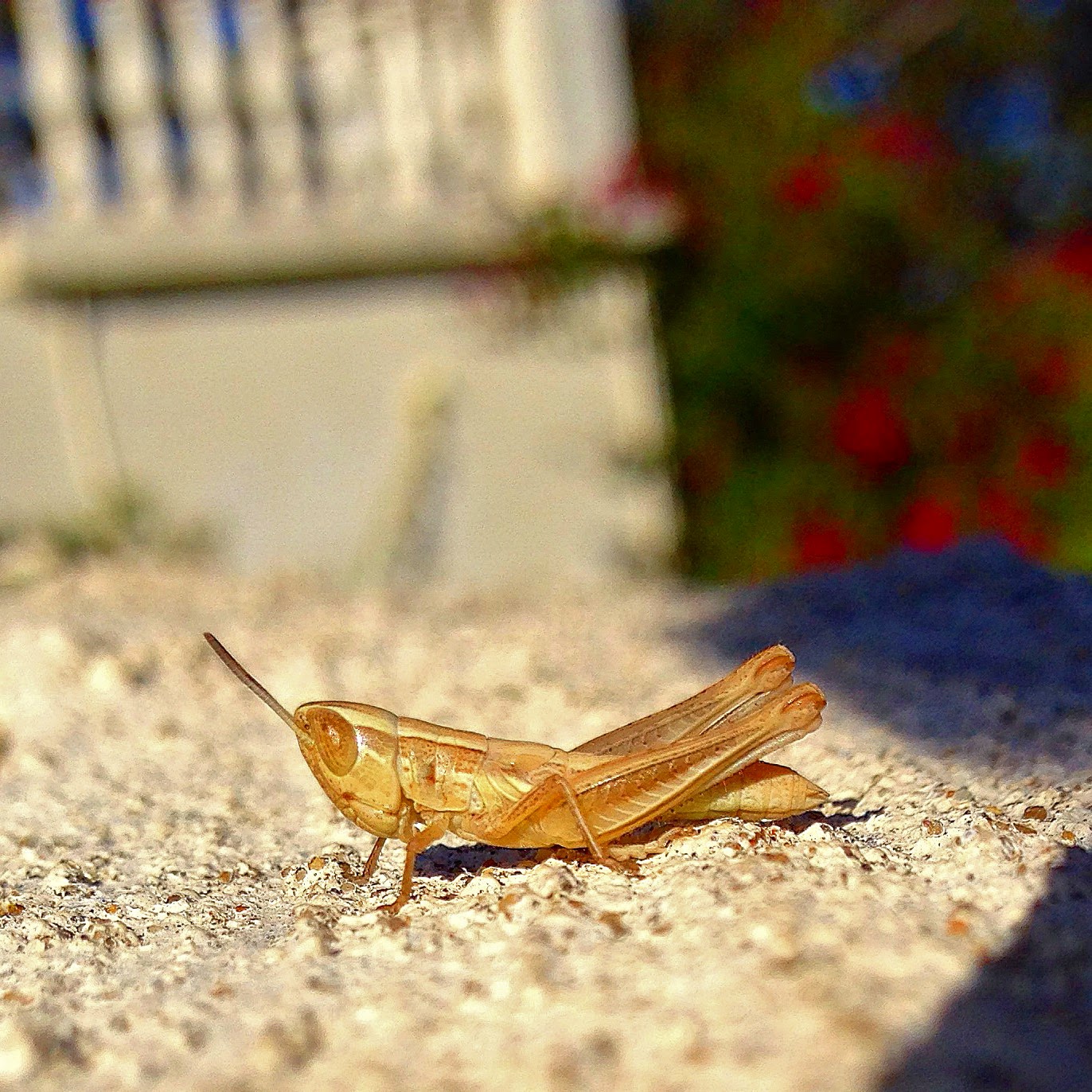
This is probably the cutest thing I have ever seen, a baby grasshopper! This nymph was spotted jumping up and down in our garden from mulch to dry grass to pavement. It has the perfect camouflage and jumps away even before you can get a look, let alone click a picture.  

I am pretty chuffed I got this shot! Look closely and I'll tell you why it is a grasshopper and not a cricket.
Grasshopper Nymph

The antennae are short, shorter than the cephalus, the head, which distinguishes it from a cricket. Crickets have antennae longer than their heads. Grasshopper nymphs do not have wings. The nymphs have remnants of semi rigid wings which fully form when they grow up to be adults. 

The most interesting fact is that Grasshoppers have 'ears' (Tympanum, auditory sensory organ) on their first abdominal segment, behind the third pair of legs. You can actually see the ear like structure in the picture below! Look behind the behind the feather like corrugated hind limb.
Macro image of Grasshopper Nymph
Macro Image of Grasshopper nymph with it's tympanum marked out.
While the Grasshoppers have their ears on their abdomen, crickets have it on their fore legs!

I have concluded that it is a nymph of the common field grasshopper of genus Chorthippus.

Location: Western Australia, South West
Season: Summer, December
Spotted in daytime.

Subphylum: Hexapoda 
Class: Insecta 
Order: Orthoptera 
Suborder: Caelifera
Family: Acrididae 
Genus: Chorthippus

References: Brisbane InsectsWikipedia