Featured post

Nymphs of Green Shield Backed Bug: Coleotichus costatus

Nymphs of Green Shield Backed Bug sitting on Red-Eyed Wattle. Note the seeds and the seed pods. Nymphs of Green Shield Backed Bug wit...

Showing posts with label odonata. Show all posts

Friday, 27 November 2015

Black Faced Percher: Diplacodes melanopsis

Location: seasonal swamp, still water,
Bunbury, Western Australia
Season: Spring/Summer
Class: Insecta 
Order: Odonata 
Family: Libellulidae 
Genus: Diplacodes
Diplacodes melanopsis

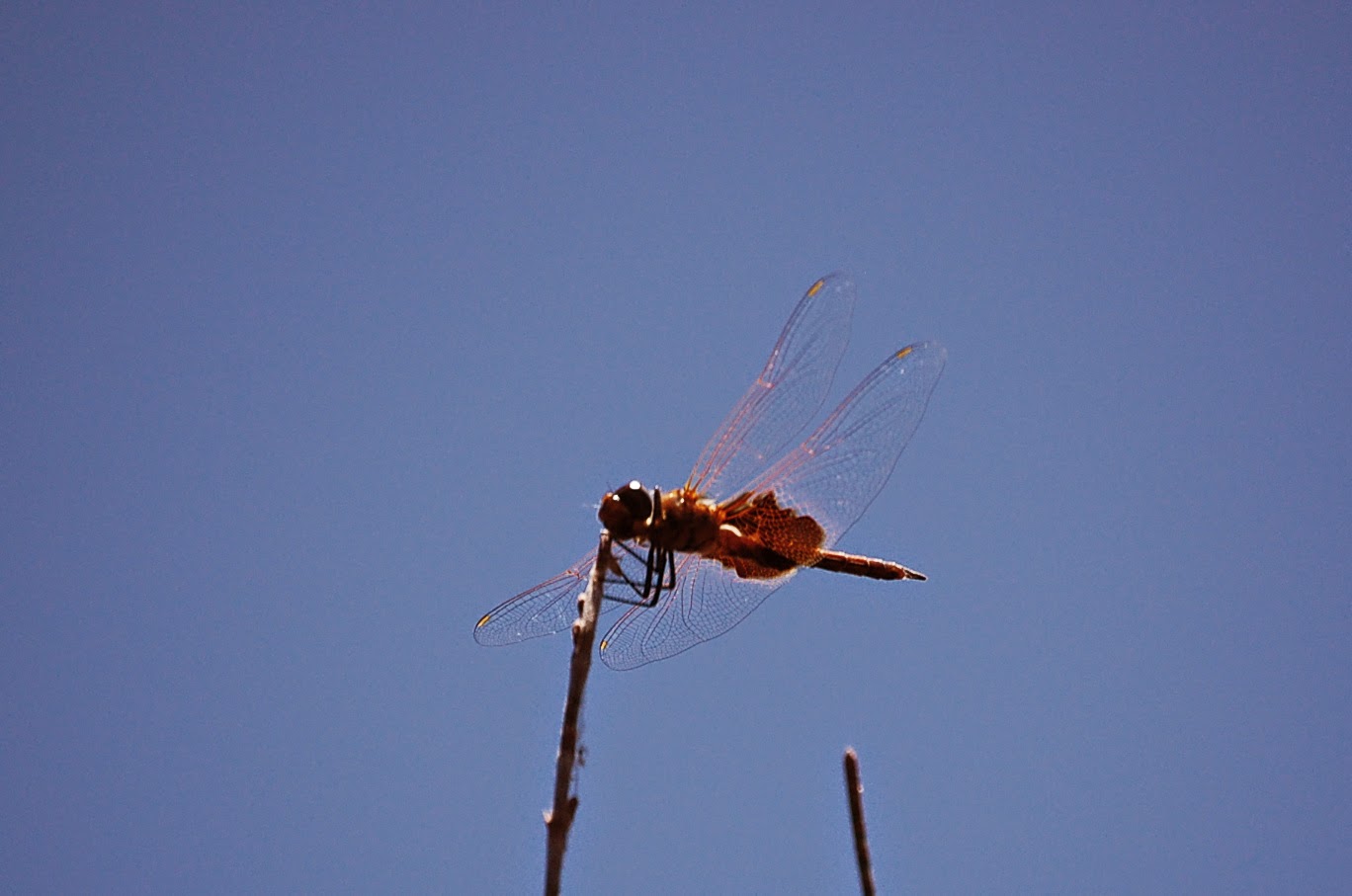
Black Faced Percher is a medium sized dragonfly measuring about 5 cms in length. It has a bright scarlet red body. The eyes, head and the thorax are dark red to black, hence the name Black Faced Percher. The abdomen has black markings on each segment on the bright red background. It can be (easily) distinguished from the other red coloured dragonflies, the Scarlet Percher and Wandering Percher by the markings on the abdomen. While the Black Faced Percher has dark (heart shaped) markings on each abdominal segments, the Wandering Percher has smaller less prominent markings and the Scarlet Percher has no markings at all. The Black Faced Percher, of course, has a black head and thorax which are red in the other two.

This Black Faced Percher's perching pattern is parallel to the long grass but perpendicular to ground. The Scarlet Perchers perch mostly parallel to the ground. One other difference is the wings of the Scarlet Percher has red patch at the base of the hind wings. The Black Faced Percher has clear wings with black pterostigma and a small area of red patch very close to the border of both hind and the fore wings.

Reference: Brisbane Insects

Sacrlet Percher: Diplacodes haematodes

Class: Insecta 
Order: Odonata 
Family: Libellulidae 
Genus: Diplacodes
Diplacodes haematodes

Scarlet Percher is a completely red coloured dragonfly with bright red eyes, head, thorax and abdomen. The abdomen lacks markings which distinguishes it from other red dragonflies, the Black Faced Percher and the Wandering percher. The wings are clear with red patch at the base of hind wings, red costa and red pterostigma. The above is a picture of a male. The females are paler red to yellow in colour. The female has black marking on the abdomen. There is a yellowish brown coloration to the wing tips of the female.

The Scarlet Perchers tend to perch parallel to the ground around water bodies, appearing to sun themselves. They often compete with each other and with much larger Blue Skimmers for perching spots.

Friday, 23 January 2015

Aurora Bluetail: Ischnura Aurora

Aurora Bluetail, Male

Aurora Bluetail, Female
Location: South West Coast, Western Australia
Season: Summer, January
Order: Odonata 
Suborder: Zygoptera 
Family: Coenagrionidae 
Genus: Ischnura
Ischnura aurora

The above male and female Aurora Bluetail Damselflies were spotted on two separate occasions, in separate parts of my garden, making me assume that there are many of these living in the area. There is no fresh water source close to the garden. The vegetation is dry but both were on relatively greener and cooler parts.

These are tiny damselflies, about 2 cms in length and very thin. The male has metallic green thorax with black antehumeral stripes. The abdomen is red with a bronze tip and a green ring, ends with a blue 'tail'. The female is all green. It was quite dull in the shade but the metallic green sheen was brilliant in the sunlight. The female also has blue tail which I noticed only in the photograph. The male hovered around and didn't seem like a strong flier. The female was still but unexpectedly flew away out of my reach, which is why the picture isn't in detail.

Please see other damselflies that I have recorded in the family of Coenagrionidae:  Red and Blue Damsel and South West Billabong Fly.


Saturday, 10 January 2015

Wandering Percher Dragonfly: Diplacodes bipunctata

Wandering Percher
Diplacodes bipunctata
Female, paler than red male
Note the two black markings on the sides of the thorax
Pale rectangle on the thorax at the mid dorsal line base of both pair of wings
Black markings on each abdominal segment
Wandering Percher
Diplacodes bipunctata
Wandering Percher
Diplacodes bipunctata
Location: South Western Australia
Season: Summer, December
Order: Odonata 
Suborder: Epiprocta 
Infraorder: Anisoptera 
Family: Libellulidae
Genus: Diplacodes
Diplacodes Bipunctata

Our garden had a lot of these teneral dragonflies flashing their new delicate wings in the sunlight this summer. Wandering Percher is a small dragonfly, 3 - 4 cms in length. The hallmark of the species is the two black dots on the sides of the thorax, hence the name D. bipunctata. The eyes, thorax, abdomen are orangish red in colour. There are black markings on each abdominal segment distinguishing it from Scarlet Percher which has no black markings. The female is paler, more yellow than red. The female has a rectangular pale spot on thorax, in the mid dorsal line, extending to the pterothorax, base of both pairs of wings. Young males are yellow and turn red as they mature. Yellow colour helps the young to blend in the bush for protection.

24/11/2015 ETA: mating Wandering Perchers, the female is laying eggs into the water.


Chalky Percher Dragonfly: Diplacodes trivialis

Chalky Percher, Female
Diplacodes trivialis
Chalky Percher, Female
Diplacodes trivialis
Location: KRS Mysore, India
Season: Early Winter, November
Order: Odonata 
Suborder: Epiprocta 
Infraorder: Anisoptera 
Family: Libellulidae 
Genus: Diplacodes
Diplacodes trivialis

This dragonfly was spotted perching on the wall in the vicinity of the famous KRS dam in Mysore. These photos are examples of how the humble iPhone can elicit anatomical details with good lighting and a still subject. The best camera is the one you have at hand!

This is a female Chalky Percher Dragonfly. It is a medium sized dragonfly, about 5 to 6 cms in length. Being a female, it is bright yellow in colour with blackish brown markings on the thorax and the abdomen. The wings are clear with yellowish colouring on the wing base of hind wings. The pterostigma is yellow. Male Chalky Perchers, as the name suggests are chalky blue in colour. The young males are yellow but develop a blue colour due to Pruinescence as they mature. I couldn't spot a male anywhere in the surroundings.

 Chalky Perchers supposedly don't fly over one meter and perch on the ground. But this female chalky percher was on the second floor of the hotel where we were staying. It was early morning on a cold day and she was perching to warm herself up. She barely moved. I only noticed in the photograph that she has lost one of her limbs but she was strongly perching with 5 others.

Friday, 9 January 2015

Granite Ghost Dragonfly: Bradinopyga geminata


Location: Bangalore, India
Season: Autumn/Early Winter, October
Class: Insecta 
Order: Odonata 
Family: Libellulidae 
Genus: Bradinopyga
Bradinopyga geminata

Do you see what I see? What a camouflage! This is called the Granite Ghost because it blends with the surroundings such as granite rocks, pavements, stone boulders and walls. This dragonfly was spotted in an urban area in Bangalore, India. It was found sitting on the cement wall. How well it blended with the surroundings simply amazed me. It is grey in colour, with grey eyes and the abdomen is grey with black/white/grey marbling pattern. This morphology helps it to perfectly blend with the surrounding being practically invisible. 

The adaptation to urban environment is not just in the camouflage. It feeds on mosquitos and larvae which is abundant in urban buildings. 

The Genus Bradinopyga has four main species of which B. geminata is endemic to India. Other species are endemic to Africa. 

Australian Emerald and Tau Emerald Dragonfly: A Comparison

Tau Emerald Dragonfly
Hemicordulia australiaeBrownish eyes
Inverted T mark on the frons
Orangish leading veins on coastal margin
Brown pterostigma
Yellow mark on 10th abdominal segment
Black 7th abdominal segment
Location: South Western Australia
Season: Summer, December
Order: Odonata 
Family: Corduliidae 
Genus: Hemicordulia 
Hemicordulia Tau

Hemicordulia is a common species of dragonflies in Australia. Australian Emerald Dragonfly, H. australiae and Tau Emerald, H. tau are a bit tricky to distinguish in the field. However, I have learnt a few pointers towards identification. 

Similarities:
Size: Both are medium sized dragonflies, about 5 to 6 cms in length.

Perching pattern: H. tau and H. australiae both perch similarly. They hang on to the tip of the branches perpendicular to the ground. This feature makes it easy to distinguish the Hemicordulia dragonflies from other yellow dragonflies such as female Blue Skimmers, Yellow Striped Hunters which rest parallel to the ground. 
Hemicodulia species perch on higher branches and settle there for longer periods.

 Abdominal markings: Both have metallic dark green pattern over orangish yellow colour. This colour shines brilliantly in sunlight giving the name Emerald. The thorax is yellowish grey. 

Differences between H. australiae and H. tau 
Eyes: Mature H. australiae has bright greenish blue eyes that dazzle in the sunlight. H. tau has brownish eyes. 

Abdomen: H. tau has a yellow spot on the 10th abdominal segment (tip of the tail)
The seventh abdominal segment is darkly coloured in H. tau whereas the yellow marking is present in H. asutraliae.

Head: Inverted T shaped mark on H. tau is the telltale feature, hence the name. This is not present on H. australiae.

Wings: H. australiae has clear wings. The veins are black.
H. tau has brownish red to orange leading viens. The pterostigma is brown. 


Again, I present you with a not-so-spectacular image of H. australiae. It is about time I got a better picture of the Emerald, but some features are still remarkable in the photo below.

Australian Emerald
Hemicordulia asutraliae
Bright greenish blue eyes
No T mark on the frons
Clear wings with black veins.
Black/clear pterostigma
7th abdominal segment has yellow/orange marking

Australian Emperor Dragonfly: Hemianax papuensis


Order: Odonata 
Family: Aeshnidae 
Genus: Hemianax 
Species: H. papuensis 
Hemianax papuensis

It is a large dragonfly, easily identified by its sheer size compared to other dragonflies. It is about 8 cms in length. It is yellow with dark brown markings on the abdomen. The thorax is pale grey and the forehead has a T shaped mark (click on the photo to enlarge). It rests like Australian Emerald Dragonflies, perpendicular to the twig. It settles on higher branches, not easily disturbed. 

How this dragonfly flies is interesting as it uses its own movement to hide itself and attack its prey. It flies in line with the target so as to appear stationary to the target but is actually looming closer. This mechanism of attack is called Motion Camouflage, first described in Australian Emperor Dragonflies.

Reference: Wiki

Thursday, 8 January 2015

Common Glider Dragonfly: Trapezostigma loewii

Common Glider Dragonfly
Male

Male Common Glider Dragonfly in flight
Common Glider Dragonfly
Male
Location: Big Swamp Wildlife Park, Bunbury, Western Australia
Season: Summer, January
Order: Odonata
Family: Libellulidae
Trapezostigma loewii
(previously Tramea loewii)

This dragonfly is easily identified by the red colour base on the hind wings and the red coloured body. The larger wings for its body and the red base make this dragonfly look large. It is a strong flier. It glides in the sky which gives it the name Common Glider. The wing base gives it the name Saddleback Glider. It flies high and perches on the highest branch.

Reference: Brisbane Insects, Wiki

Blue Spotted Hawker: Adversaeschna brevistyla

Blue Spotted Hawker in flight
male

Location: Big Swamp Wildlife Park, Bunbury, Western Australia
Season: Summer, December
Order: Odonata 
Family: Aeshnidae 
Genus: Adversaeschna
Adversaeschna brevistyla

This is a large dragonfly, about 7 to 8 cms long. It is a strong flier and hovers around about 3 to 4 feet above ground. It tends to stand still in flight and exhibits swift bursts of motions. I have seen Blue Spotted Hawkers hovering around water, while being chased away by territorial Blue Skimmers. This dragonfly is brown in colour with yellow stripes on the thorax and yellow spots on the thorax. The wings are golden in colour. What stands out is the blue eyes and the blue spots on the base of the wings, hence the name. Blue eyes are specific to males, females have brown eyes. The blue spots are visible from a distance, even when in flight. 

South Western Billabong Damselfly: Austroagrion cyane

South Western Billabong Fly, Male
South Western Billabong Fly, Male 
South Western Billabong Fly, Female
South Western Billabong Fly, Male and Female Mating
Bluer one on the right is male, the left paler fly is female

Location: Big Swamp Wildlife Park, Bunbury, Western Australia
Season: Summer, January
Order: Odonata 
Suborder: Zygoptera 
Family: Coenagrionidae 
Subfamily: Coenagrioninae 
Genus: Austroagrion
Austroagrion cyane

This is a very tiny damselfly, about 3 cms and very thin and needle-like. It is relatively easy to spot the males as the bright blue colour stands out when they perch on plants. They are often seen fighting for a perching spot. They live close to waters, near the shallows. I have rarely seen them fly over water. 

The males are bright blue in colour. The females are paler and  have blue rings on the tip of the abdomen. The couple above were mating high up on a tree. They were staying still for a long time, rarely moving. They stayed in the wheel position for a long time (throughout my 20 mins skype convo plus atleast 10 mins to get a good photo!).

I think this damselfly is South Western Billabong Fly. It is considerably smaller than Wandering Ringtail, with no ring at the tip of the abdomen. I don't think it is a Blue River Damsel because the blue eyes of this damselfly has a black bar, not spots as described for Blue River Damsel. Esperance Fauna Blog has beautiful pictures and description of South Western Billabong Fly which confirmed my identification.

Red And Blue Damsel: Xanthagrion erythroneurum

Red and Blue Damsel perching
Red and Blue Damselfy couple. The brighter one is the male, paler is the female.

Location: Big Swamp Wildlife Park, Bunbury, Western Australia
Season: Summer, January
Order: Odonata 
Suborder: Zygoptera 
Superfamily: Coenagrionoidea
Family: Coenagrionidae 
Genus: Xanthagrion 
Xanthagrion erythroneurum

I found these in the Big Swamp Wildlife reserve in Bunbury, where they are abundant this time of the year. They stay at the edge of the shallow waters, occasionally flying over the water. They perch on to the vegetation and easily disturbed by other damselflies and dragonflies. The mating couple fly low over the water, resting on twigs floating on the water surface. 

They are extremely tiny, about 5 cms and extremely thin, almost invisible to the naked eye! The males have bright red head and thorax, dark abdomen and blue bands on the tip on the abdomen. The females are paler, the head is pale red and the blue tip is not easily visible. 

Sources: Wiki, Esperance Fauna 

Wednesday, 31 December 2014

Blue Skimmer Dragonfly: Orthetrum caledonicum

Blue Skimmer Dragonfly
Orthetrum caledonicum
Location: Western Australia, South West
Season: Summer, December
Order: Odonata 
Suborder: Anisoptera 
Family: Libellulidae 
Genus: Orthetrum 
 Orthetrum caledonicum

Blue Skimmer Dragonfly is commonly found in Australia. It is powder blue in colour, hence the name Sky Blue Dragonfly. The fly's body has a waxy coating and when light passes through the colloidal wax, all light is absorbed but blue light is scattered by the particles, making the insect look blue (Tyndall Effect). The process of colour change is called Pruinescence.
Blue Skimmer Dragonfly with remnants of yellow still on the abdomen undergoing pruinescence
The young males, which are freshly moulted from the larval stages are yellow in colour. This is before they are coated with the waxy substance which results in the blue colour. The colour changes from yellow to blue can be seen in maturing males. Males and females look different. The female is not blue at all, even the mature ones.

In the two photos below, the dragonfly is yellow, which could be a young teneral male or a female. 
Young Teneral Male or Female Blue Skimmer Dragonfly 
When I first saw this yellow dragonfly which is actually a Blue Skimmer, I confused it with the Australian Emerald Dragonfly (and misquoted it on Instagram). The description and pictures in the field guides I read had stark similarities. Two things confirmed for me that these are Blue Skimmers. One, I actually saw the process of Pruinescence as demonstrated in the second photo. Two, I actually spotted an Australian Emerald Dragonfly! Please pardon the quality of the picture below, I must get a good shot next time. But the metallic green coloured markings on the abdomen can be seen. The eyes are bright greenish blue. 
Australian Emerald Dragonfly
Could be a Tau Emerald as T mark is not visible in the photo
Hemicordulia australiae

Sunday, 28 December 2014

Blue Ringtail Damselfly: Austrolestes annulosus


Location: Western Australia, South West
Season: Summer, December

Order: Odonata 
Suborder: Zygoptera 
Family: Lestidae
Austrolestes annulosus

Very pretty and very delicate! The Blue Ringtail Damsel Fly was found sitting in my garden, which is pretty dry at this time of the year. This damselfly is supposed to be found near creeks and water sources. Simple way to distinguish between dragonflies and damselflies is position of the wings when they rest. Damsel flies neatly fold their wings while resting whereas the dragonflies spread them apart.

This is called the Blue Ringtail because the end of the tail has a ring, as seen in the above photo. 
Reference: Brisbane Insects